
Learning Centre
How to Select Fire Rated Doors for Large-Scale Projects

Understanding Fire Door Ratings
FRR (Fire Resistance Rating) indicates how long a door is certified to resist fire, with ratings available in 30, 60, 90, 120, 180, and 240 minutes. But here’s the catch: the rating must align with the surrounding wall or compartment to ensure effective protection. Overspecifying can drive up budgets, while underspecifying can lead to compliance issues.
In higher-risk areas—like boiler rooms, plant areas, or hazardous storage—longer resistance is often required to slow fire spread, protect structural integrity, and limit building damage. Smoke control is just as critical, especially along escape routes where visibility and breathable air are essential. And it’s not just about the door itself—certified assemblies ensure the entire system functions reliably as intended under test conditions and real-world pressure.
Role of Fire Rated Doors in Passive Fire Protection Systems
Within passive fire protection systems, doors are what make compartmentation actually work. They help protect escape routes, isolate fire zones, and contain fire within specific areas—giving occupants the time needed to evacuate safely without chaos or delays.
Without properly specified doors, even well-designed fire compartments can fail. Doors must close reliably, seal effectively, and remain operational under extreme conditions. This is what allows buildings to contain fire long enough for safe evacuation and emergency response, especially in high-occupancy environments.
Choosing the Right Fire Doors for Large-Scale Commercial Projects

Not all industrial fire doors serve the same purpose. The right choice depends on opening size, traffic frequency, operational workflow, automation requirements, and overall building design constraints. Getting this wrong can create bottlenecks, increase wear, or disrupt daily operations.
That’s where selecting the right door type becomes critical:
- Fire roller shutter doors are ideal for industrial settings like warehouses, loading docks, and logistics hubs. Their vertical operation maximises usable space while offering robust fire containment and smooth integration with alarm systems.
- Fire sliding doors are better suited for wide openings and internal compartment boundaries. They perform well in high-traffic zones where durability and automated closing are essential during fire events.
- Fire curtains are the go-to solution where aesthetics or space constraints matter. Common in shopping centres, airports, and large commercial buildings, they remain discreet until deployed, offering flexible zoning without compromising design intent.
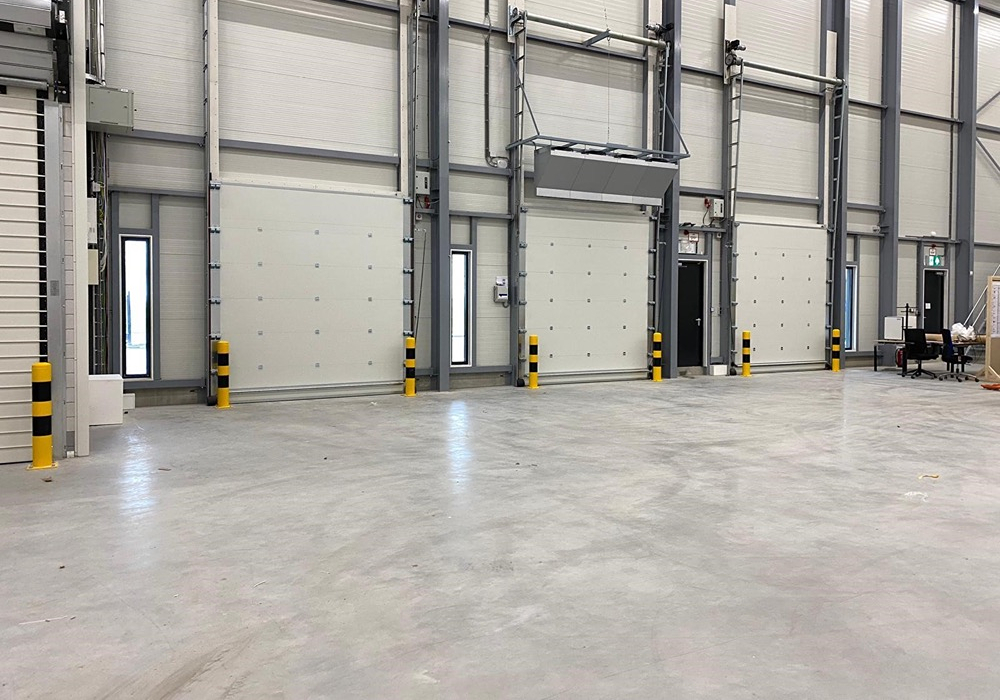
- Fire rated sectional doors work well in commercial garages, workshops, and service depots. Their insulated panels support energy efficiency while maintaining consistent fire resistance and operational reliability.
Each option is designed to support specific workflows—so the right choice keeps operations moving smoothly instead of creating bottlenecks or downtime.
Materials, Construction, and Hardware Considerations
Most fire doors for commercial buildings rely on non-combustible materials such as steel or mineral core construction to achieve required resistance levels. But performance comes down to more than just materials.
Intumescent seals expand under heat to block smoke and flames, while certified glazing panels allow visibility without compromising fire integrity. Heavy-duty hardware and self-closing mechanisms ensure doors function consistently—even in high-use environments. These components are critical in ensuring doors don’t just meet standards on paper, but perform reliably over time.
Compliance, Testing, and Certification Requirements
Meeting fire safety compliance involves more than selecting a rated product. It requires adherence to local building codes, correct installation, and ongoing maintenance.
Fire rated doors must be tested and certified as complete systems, with clear labelling to confirm compliance with recognised standards. Regular inspections are essential—especially in high-traffic environments—to ensure doors continue to perform over time. Neglecting maintenance can compromise both safety and certification.
Operational Factors in Large-Scale Facilities
Here’s where many projects fall short: overlooking how doors are actually used. In large-scale environments, doors are part of daily operations—not just emergency systems.
- Automation: Automation plays a role in long-term performance.
- Fire Alarm Integration: Integration with fire alarms supports overall system effectiveness.
- Traffic Flow: Traffic flow impacts how the system performs in daily operations.
- Maintenance Planning: Maintenance planning contributes to long-term performance.
- Workflow Disruption: A poorly chosen system can disrupt workflows.
- Downtime & Bottlenecks: It can increase downtime or create bottlenecks in high-traffic areas.
- Lifecycle Cost: Lifecycle cost is another key factor—what seems cost-effective upfront may not hold up under continuous use.
Working with Specialists for Project-Specific Fire Rated Doors Solutions
Large projects rarely have straightforward requirements. Working with specialists ensures fire rated doors are specified correctly based on building layout, compliance needs, and operational demands.
Experienced providers like Glideaway bring specialised expertise in designing, manufacturing, and integrating fire-rated door systems tailored to complex industrial and commercial environments. From early design coordination to installation and long-term support, this ensures solutions are aligned with both compliance requirements and day-to-day functionality—reducing risk while improving performance across the building lifecycle.
Conclusion
Selecting fire rated doors isn’t just about meeting a rating—it’s about helping your building perform safely and efficiently when fire risks arise, keeping operations running and people protected. The right combination of fire shutter doors, fire sliding doors, fire curtains, and fire rated sectional doors can strengthen compartmentation, support operations, and ensure full fire safety compliance.
For large-scale projects, aligning door selection with passive fire protection systems, building design, and operational demands is key. Taking the time to specify correctly and working with experienced specialists helps deliver safer, more efficient, and future-ready environments without compromise.
Discuss your large-scale project requirements with Glideaway’s specialists to identify fire door systems that meet compliance, support smooth operations, and perform reliably in high-demand environments.

Let’s talk garage doors.
Have a question or need advice? We’re here to help. Speak to our team about your project, and let’s find the perfect door to suit your site and style.